 Alliance for Catholic Education
I’m currently teaching an undergraduate course called Youth, Schooling, and Society. The students just finished reading Segregation by Experience (Adair & Colegrove, 2021) that centers on Ms. Bailey and her approach to teaching her first grade students. The researchers describe the culture Ms. Bailey cultivates as “vital mattering,” which they define as “being able to move, explore, create, participate, collaborate, communicate and enact agency in what matters to them in order to matter to themselves and one another” (Adair & Colegrove, 2021, p. 58). Children in her classroom knew they mattered - to their teacher, to themselves, and to one another. Their ideas mattered and were taken seriously.
This past week on our immersion trip, we were able to see this type of vital mattering lived out at two Catholic schools: St. Madeleine Sophie and Bishop Blanchet. Both schools demonstrated the power of nested communities and how those communities interact and influence each other. At. St. Madeleine Sophie we saw how a culture of joy among the teachers enabled them to create a culture of joy among their students. The teachers talked with us about how much they love their jobs and we saw that lived out as we observed their classrooms. We saw teachers encourage students to collaborate with one another to answer questions, to search for hidden objects in early childhood classrooms, and to determine their own purpose at the start of reading A Wrinkle in Time together. This culture of joy and welcoming extended to us as well. One student gave one Remick leader the moniker “tie guy” in appreciation of his tie. In every classroom we visited it was evident that every child had a place and every child’s ideas mattered.
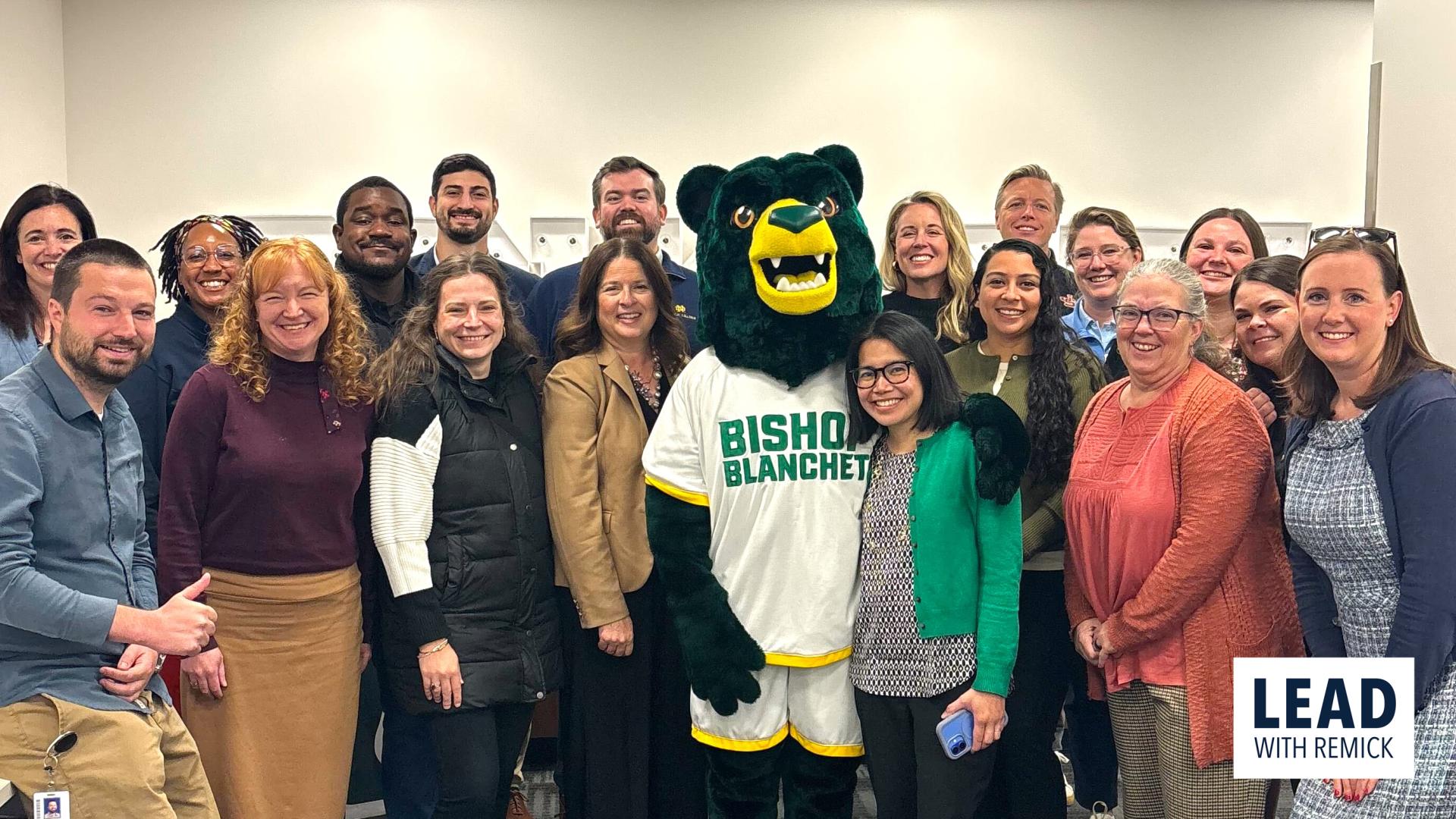
At Bishop Blanchet we were joyfully welcomed into the building by the marching band and Chet the Bear! Students came in early on a late start day just to welcome us. We saw teachers whistling and singing to themselves while making copies, teachers joyfully greeting one another and each of us in the hallways, and met a significant number of teachers who graduated from Blanchet and have come back to teach. The student panel movingly talked about individual teachers who encouraged them to take on leadership roles, who made sure they felt known, loved, and seen, and who supported their attempts to start new clubs and initiatives.
One thing we did not hear much of across either school was no. We heard leaders say yes to families who have children who have additional needs (financial, academic, behavioral), we heard teachers say yes to students who wanted to start clubs and be involved in multiple activities, we heard students say yes to other students when asked for help or asked if they could play. As you continue to cultivate the culture in your own schools, consider how you might be able to say more yeses than nos. How might you explore your own school with a new set of eyes to see what signs of vital mattering you might encounter on a typical day? When we can create spaces where the ideas and interests of everyone matter, we can affirm the humanity, sustain the joy, and honor the inherent dignity of each member of our beloved communities.
Betsy Okello
Faculty, the Mary Ann Remick Leadership Program