 Alliance for Catholic Education
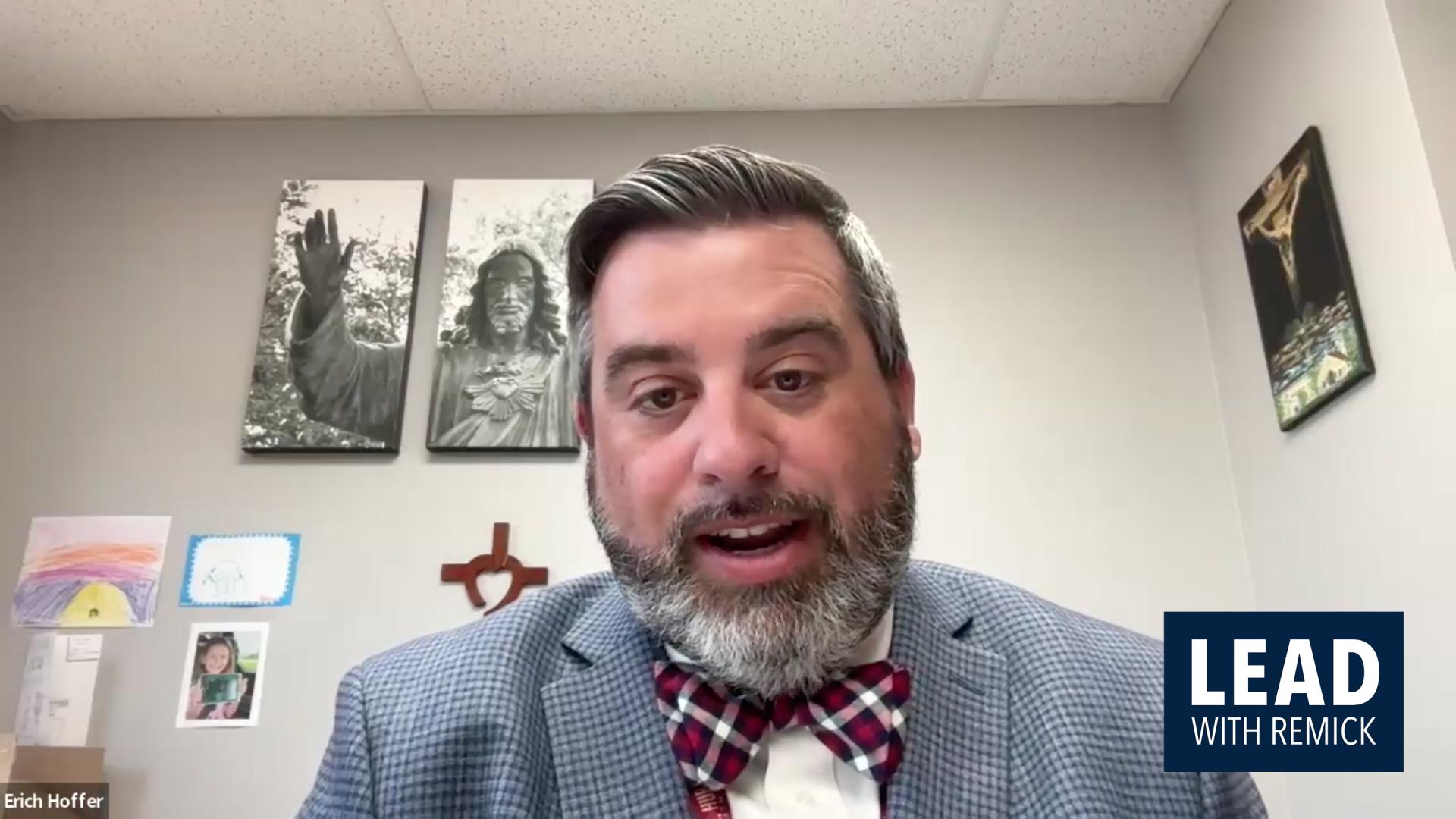
Interview with Erich Hoffer
President of St. Hubert Catholic School, Chanhassen, Minnesota
Kevin Baxter: Hello everyone, I'm Kevin Baxter, the Director of Mary Ann Remick Leadership Program, here with Erich Hoffer, who's the president of St. Hubert Catholic School.
In Minnesota, Erich is also one of our, stellar executive coaches, and has been very closely tied to the program for years. And we're here to talk a little bit about Champion's Culture, which is the value of the Remick Leader that we're focused on this month. And I'll just highlight what we say about Champion's Culture in our document.
It internalizes Christ's mandate, go forth and teach within the school's mission and vision statements. It identifies and articulates the beliefs and values that animate the school community, that promotes an unapologetically child-first approach. It affirms the humanity, sustains the joy, and honors the inherent dignity of each child. So, Erich, first of all, thank you so much for joining us, and talk a little bit about how the value of Champions Culture occurs in your work at St. Hubert.
Erich Hoffer: Yeah, Kevin, first of all, thank you for allowing me to be here. And as a Catholic school leader, especially in an elementary school, you think about championing culture means intentionally shaping your environment where faith, academics, and community are deeply intertwined on a daily basis. Each day.
You know, we talk about modeling gospel values in all of our interactions. So, whether it's with students, with staff, with families, to ensure that our school culture reflects that dignity of every person that we are involved with. And that shows up in everything from the way we start our day in prayer, to how we address discipline, to how we celebrate student and staff achievements, to how we talk, from the most important person on campus to the person that maybe nobody even knows their name. And so, you know, we believe in the power of dignity of each person, and it's something that we curate daily, right? It's the small interactions, it's the consistent, small things we do through clear communication. Talking about our root beliefs, living those out each and every day. And so, in small ways, we see it every day here at St. Hubert, and it leads to a much larger, coherent picture.
Kevin Baxter: It's beautiful. It's a beautiful description and a beautiful picture of what it looks like in practice. I know you fairly well, and I can kind of imagine the answer to this question, but what do you excel at within this… within this value? What do you think you really particularly bring to this work?
Erich Hoffer: Wow, I appreciate that question. I would say one of my strengths is creating a strong sense of belonging, bringing people in. I'm intentional about being present, I think I listen pretty well, and I recognize the gifts of each person and what they bring to our community, and I want to share that with everyone, and I want everyone to recognize those gifts in other people.
And so, I prioritize clarity and vision, consistency and expectations, and that helps foster trust and unity across our staff, and that brings in people as well. When people feel seen, and when people feel heard, and when people trust leadership, you can do some pretty amazing things. So, yeah, I would say bringing people in. Belonging is my greatest strength there.
Kevin Baxter: It's beautiful. That's great. Talk a little bit about your leadership journey. You've had, I don't want to say unique, but a special experience of, I think, at least 3 dioceses, right? Yeah. In terms of your experience. Talk a little bit about that, what brought you to, to Catholic schools and Catholic school leadership.
Erich Hoffer: Yeah, I'll be honest with you, Kevin, I kind of fell into it. I'd finished college and was dead set on going to law school, and got invited to be a volunteer with the Brothers of the Sacred Heart Volunteer Corps. Very similar to ACE Teaching Fellows, except that I didn't get a degree or get to go to Notre Dame. I was volunteering down south.
Right, outside of New Orleans, and what a special gift. I was there, I taught elementary school PE and science in the mornings, and then I was teaching social studies and government in the afternoons at the high school, and so I got to see the full gamut of Catholic education on the Mississippi Gulf Coast.
And, was there for Hurricane Katrina, and I'll be honest with you, Kevin, that sealed the deal for me in staying in education. There's no way I could have left that community. It became part of my soul, became part of who I was, and really led me down the path of who God created me to be. And so, started there, was there for 17 years, and was…really, invested in the school, and somebody said, you know what, Erich, you should really look at leadership, and, called April. And, turned in my application the day before it was due for the Remick Leadership Program, and, by God's blessing, got in and, graduated, moved to Denver to take on a principal's role.
And did that through COVID, and became president of the Archdiocesan High School in Denver. And then, home was calling. And so, Dr. David Sorkin, another, person from our program, had called me and said, Erich, if you were looking to get back, here's an amazing opportunity here in Minnesota. And so here I am as the president and head of school. And so it's been an amazing journey from teaching and coaching and being a academic advisor to a classroom teacher to a lunchroom supervisor. As you know, we wear about 1,400 hats in Catholic education. I think I've worn a lot of them, and just blessed to be here, and I'm truly doing what God created me to be, and I'm just really thankful for that.
Kevin Baxter: That's great, that's great. I also think those experiences, just so varied, and obviously different geographies, but through Katrina and your experience down there, really helps you to see culture, too, and thinking about this in terms of the environment that students are being educated in, and that kind of idea of culture that surrounds them, right? That kind of helps to form them into who they need to be.
What's your favorite thing about working in a Catholic school? I think we've kind of heard it, it's already kind of come through a little bit, but what would you say is your favorite?
Erich Hoffer: I think my favorite thing is watching the light go on in a child's eyes, that they understand, whether that's an academic excellence pursuit, or the fact that someone knows their name, or that you remembered their birthday. It just… watching that growth of the whole child, and watching them light up, because they know that somebody loves and cares about them, and wants to lead them to a path of growth. And so seeing students develop, just not only in knowledge, but in character, and in faith, and in friendships, and in relationships, that's something that's deeply rewarding. And when students really discover, as I did later in life, but when students really discover what God created them for, that's awesome, and they begin to live that identity, and for me to be a part of that, and forming that, and shaping that. It's just a true honor.
I also love the opportunity to pray and celebrate with my kids every day. It's fun to walk into a classroom and they think you're a rock star. You know, those… those awesome relationships are just that are unique to Catholic schools, because it's rooted in something deeper than just a friendship or a relationship, it's rooted in faith. And so, being part of that is just an absolute sacred honor.
Kevin Baxter: Yeah, it's great. I remember when I was a principal at elementary school, if I was having a bad day, kindergarten was where I wanted to go. Amen, amen. Always happy to see you. Always excited.
Erich Hoffer: You'd probably get a snack and a nap out of the deal.
Kevin Baxter: That's right. You also, because you've been to a few different places, and now, you know, you're a coach for us, so you have, experiences with Remick leaders who are all around the country. If you look at the landscape, kind of take a step back, what's a challenge that you see, the Catholic schools are dealing with right now, or that you think is something we need to be thinking about more intentionally?
Erich Hoffer: Yeah, Kevin, I would say sustainability is a major concern. Financial pressures, declining enrollment, challenge of recruiting and retaining faith-filled, mission-driven teachers and leaders, those are real issues. And I also think there's some cultural challenges that we're facing, you know, in an increasingly secular world. It takes more intentionality to form people to that Catholic worldview that you talked about, and your definition. And I think there's an opportunity there, too, that if we stay rooted in who we are and our identity, while also engaging the world in ways that are both, I would say courageous, but compassionate at the same time, we can do some amazing things. And we have to balance the tradition of our faith with the innovation of moving forward as teachers and leaders, and that ongoing leadership task of bringing people closer to Jesus. So, I think you know, we talk about challenges as opportunities all the time, and we are… we are ripe with, the opportunity to take some of those challenges and really turn them into opportunities to change the world around us in a… in a world that I… you and I think… probably both think desperately needs it right now, so…
Kevin Baxter: Absolutely. And you kind of turn that challenge into an opportunity, but I'm also thinking, from that same kind of maybe national, or at least wider perspective, what's, what are the bright spots? What are you seeing that gives you hope that that world you're describing is taking place?
Erich Hoffer: Yeah, I think there's a renewed energy and a sense of purpose in many of our Catholic schools today. We realize the challenge in front of us, and it's not just, we can't just sit on our laurels anymore, but we really have to move. And, you know, I also start… I'm seeing a lot of growing interest from families who are seeking that type of education. They're coming to us going, there's something different here, what is it? And they want to be a part of it. So, you know, our ability to form students in faith and virtue is something… it's unmatched. You know, Catholic schools have been doing it for so long, and it's incredible. We're still delivering amazing academic rigor. And that's increasingly appealing,
You know, to a lot of people, and I'm really excited about that. And I'm also really encouraged by our church and our leaders in Catholic schools right now really jumping forward in, like, innovation, whether it's curriculum, leadership development, faith formation, we've kind of gotten up off the bench and said, you know what, we really have to work at this, and we could be amazing, and we're finding creative ways to thrive while remaining grounded in our tradition and battling through the things like, you know, not very many resources or declining enrollment, but we're still doing some amazing things, and that's exciting to me.
Kevin Baxter: Yeah, it is that secret element of Catholic schools that's really hard to capture sometimes, but when you walk on a campus that's really totally embraced, I'm sure St. Hubert's like this, you can just feel it, and I think one of our challenges, even from, like, a… if you think about it from, like, an academic research perspective, is how do you capture that and tell that story in kind of a data-driven way? Because it is such a sense of belonging and connection and commonality around faith and belief, but it really is an environment where we experience firsthand, kids just, you know, flourish and thrive and grow, so it's a beautiful description of the hope, the hope that we have in the future, right?
Erich Hoffer: Right.
Kevin Baxter: Well, Erich, thank you so much for joining us. It's been a pleasure speaking with you, and God's blessings on all your work there at St. Hubert.
Erich Hoffer: Thanks, Kevin, and I appreciate the opportunity, and just keep doing the great work you are with the Remick leaders, and go Irish!
Kevin Baxter: Go Irish!